





Florida doesn’t just attract 140 million visitors a year—it funnels them onto the same highways that carry the commercial freight keeping the state running. The FMCSA’s crash data makes clear that large trucks are involved in thousands of serious crashes annually, and Florida’s unique mix of unfamiliar drivers and relentless freight traffic puts those numbers in sharp relief. When a confused tourist makes a last-second lane change near a fully loaded semi, the consequences can be devastating for everyone nearby.
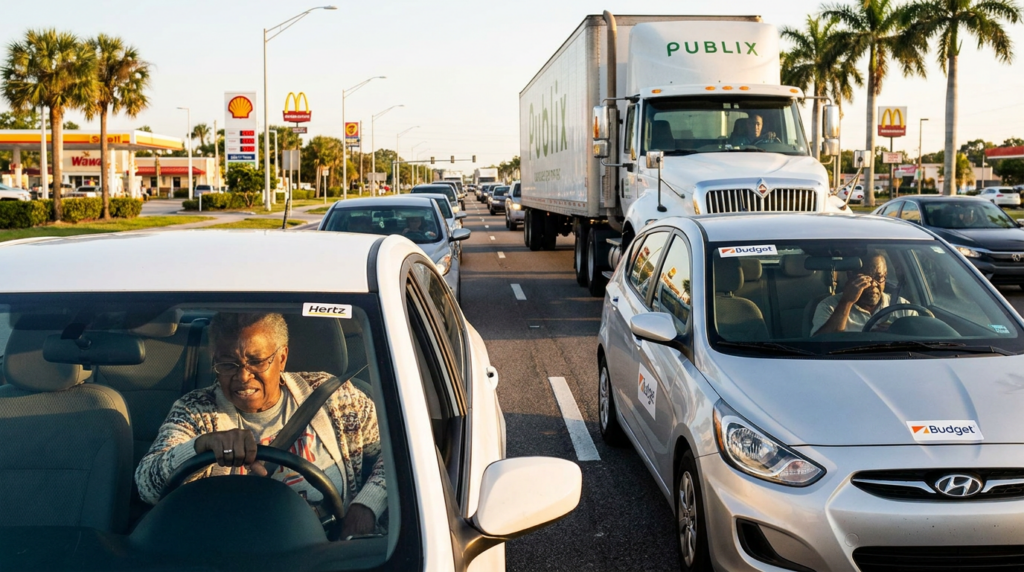
Tourist congestion, snowbird driving habits, and commercial truck traffic create a predictable pattern of collision risk—one where confusion and trucking negligence combine to cause life-altering crashes. Understanding that pattern matters, because after a serious wreck, the evidence that proves what went wrong can disappear fast. If you or someone you love has been hurt, LaBovick Law Group is ready to fight for the full compensation your family deserves.
Why Tourist Traffic and Snowbird Season Raise Crash Risk
When tourist traffic and snowbird season overlap on Florida roads, the congestion shows up fast. More vehicles are only part of the problem. The real danger is what happens when a surge of unfamiliar drivers meets road designs built for people who already know where they are going.
Volume Alone Does Not Tell the Whole Story
Florida’s crash data shows that crash frequency rises alongside traffic volume during peak travel periods. But research on driver behavior tells a more specific story. A peer-reviewed study found that even when total traffic dropped during the pandemic, fatal crashes persisted because of how people drove, not just how many were on the road. Florida’s tourist season replicates that pattern by design: it layers unfamiliar behavior onto already-heavy traffic, which is precisely what makes the seasonal surge more dangerous than raw vehicle counts suggest.
Unfamiliar Roads Create Split-Second Confusion
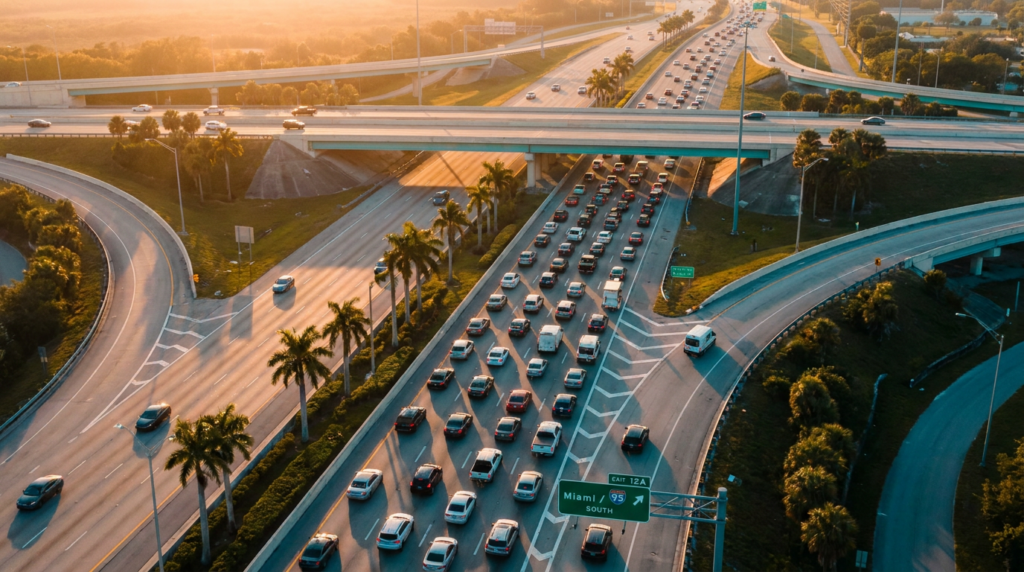
Visitors and seasonal residents often encounter Florida’s interchanges, merge points, and turnpike exits for the first time at highway speed. That moment of hesitation, the late lane change, the unexpected stop, can trigger a chain-reaction crash behind them. Local drivers can be caught off guard just as easily, since crowded roads leave far less room to react to someone else’s mistake.
Everyone on the Road Becomes More Vulnerable
Seasonal congestion turns experienced local drivers into collateral risk. A Florida driver who has merged onto I-95 a thousand times can do everything right and still get hit by a snowbird who braked for an exit they almost missed. As LaBovick’s own analysis of Florida crash patterns notes, seasonal crowding compounds other risk factors, like distracted driving and unfamiliar signage—turning one driver’s ordinary mistake into another family’s life-altering crash.
Distracted Driving and Unfamiliar Roads Make Mistakes Worse
When someone is driving through an unfamiliar city, their brain is doing two jobs at once: following the road and figuring out where they are. That divided attention is exactly where crashes begin. Florida’s roads see this play out constantly, especially during peak tourist and snowbird seasons, when a large share of drivers have never used these interchanges before. According to the Florida Highway Safety and Motor Vehicles, distracted driving contributed to roughly 300 deaths and more than 2,200 serious injuries in Florida in 2024 alone, with one in every seven crashes in the state tied to some form of distraction.
What makes unfamiliar roads particularly dangerous is that the distraction is not just a phone. It is a GPS rerouting mid-turn, a passenger pointing out an exit, or a driver slowing down to read a sign while traffic ahead has already stopped. NHTSA’s 2023 distracted driving data shows how quickly distraction turns into impact, and the IIHS notes that phone manipulation measurably impairs a driver’s ability to scan intersections and process what is ahead. In heavy Florida traffic, that fraction of a second matters enormously.
Here is what this looks like on the road and why it matters after a crash:
- Unfamiliar drivers make late decisions. A visitor unsure of their exit will brake suddenly or cut across lanes, creating conflict points that give surrounding drivers almost no time to react.
- Divided attention delays hazard recognition. Even a brief glance at a navigation screen can result in a driver missing a stopped car, a merging truck, or a changing signal ahead, all common triggers for rear-end and sideswipe crashes.
- Confusion about right-of-way leads to hesitation. Intersections and roundabouts that locals navigate automatically can cause visitors to stop, creep forward, or make unpredictable moves that disrupt the traffic flow around them.
- These crashes look routine but are legally significant. What appears to be a simple fender-bender often has a story behind it: a driver checking a phone, an unfamiliar merge, a missed signal. That pre-impact behavior is evidence of negligence that can be documented through phone records, dashcam footage, and witness accounts.
- Evidence fades fast. Contacting an attorney quickly gives injured families the best chance of preserving the proof that shows how a crash actually started—before footage is overwritten and key records are gone.
Commercial Trucks Turn Congestion Into Catastrophic Crashes
A passenger car making a sudden stop in light traffic is an inconvenience. That same move directly in front of a fully loaded tractor-trailer in dense Florida tourist traffic can send a family to the hospital. The physics do not bend for the season.
Size and Stopping Distance Change Everything
Commercial trucks can weigh up to 80,000 pounds when fully loaded, and that mass does not slow down the way a sedan does. According to the IIHS, large trucks require significantly longer distances to stop than passenger vehicles, and defective brakes contribute to many crashes. When tourists and snowbirds are braking unpredictably around an unfamiliar exit, a truck driver needs space that crowded Florida roads rarely provide.
Blind Spots Make Dense Traffic More Dangerous
Trucks have blind spots on all four sides, and those zones grow more hazardous when surrounding vehicles are bunching, merging, and changing lanes unpredictably. A visitor who drifts into a truck’s right-side blind spot while searching for an exit may never know the danger until impact. The FMCSA’s Large Truck Crash Causation Study identified driver recognition failures and vehicle-related factors as common contributors to serious truck crashes.
Liability Often Goes Beyond the Driver
When a truck crash happens in heavy seasonal traffic, the cause is rarely just one bad decision at the wheel. Maintenance failures, improper loading, aggressive dispatch schedules, and inadequate safety oversight at the carrier level all appear as factors in serious crashes, according to FMCSA research. LaBovick Law Group recovered $3.4 million for a client in a car-versus-commercial-truck crash on the Florida Turnpike, a case that illustrates how severe these collisions can be and how much evidence it takes to build a complete picture of liability. A strong truck accident claim looks at the entire chain of events, not just the driver behind the wheel at the moment of impact.
FAQ: What to Do After a Crash Involving Tourists, Snowbirds, and a Truck
After a serious crash on a busy Florida road, most people are overwhelmed before they even leave the scene. These answers cut through the confusion so you know exactly what matters and why timing can make or break your claim.
What evidence should be preserved after a crash involving tourist traffic, snowbirds, and a commercial truck?
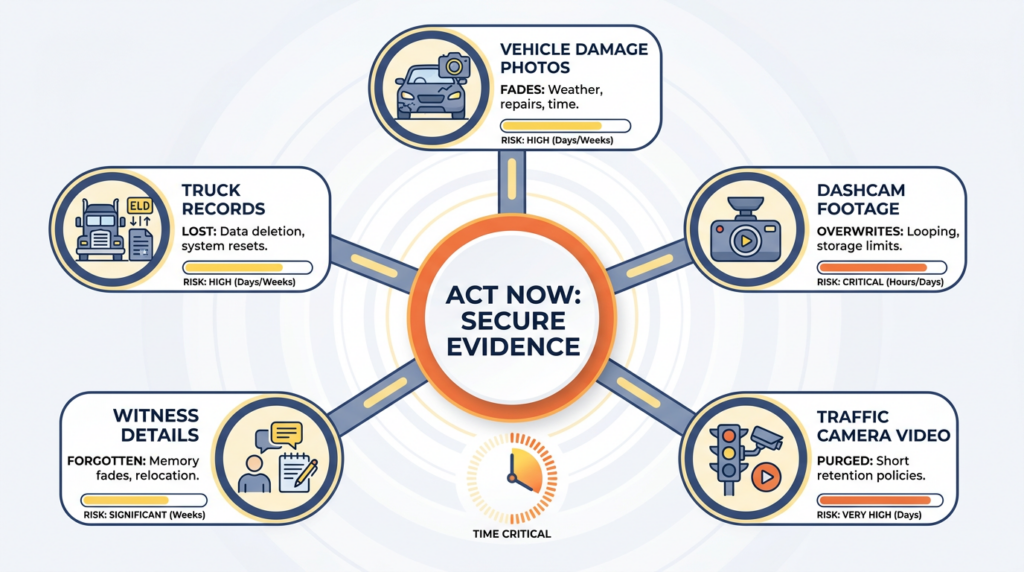
Photographs of vehicle damage, road conditions, and signage are a strong starting point. Beyond that, the most valuable evidence in truck cases includes the driver’s electronic logging device (ELD) data, maintenance records, and any available traffic or dashcam footage. As LaBovick’s truck accident negligence guide explains, witness memory fades and records get overwritten fast, so acting early matters.
Who may be liable when a truck crash happens in heavy Florida tourist traffic?
Liability rarely stops with the truck driver. The trucking company, a maintenance contractor, or even a cargo loading company may share responsibility. Florida law allows injured people to pursue every party whose negligence contributed to the crash, which is why a thorough investigation into what led to the crash matters more than focusing only on what happened at the moment of impact.
Why is it important to act quickly before insurers and trucking companies control the narrative?
Trucking companies often send investigators to crash scenes quickly. Their goal is to document the incident in a way that protects the carrier. Florida’s statute of limitations gives you time to file, but critical evidence like traffic camera footage and truck data can disappear within days. The truck accident attorneys at LaBovick Law Group outline the immediate steps that protect your right to fair compensation.
Can out-of-state visitors or tourists file an injury claim in Florida?
Yes. If the crash happened in Florida, Florida law governs the claim regardless of where you live. LaBovick Law Group regularly represents out-of-state clients injured on Florida roads. You do not need to be a Florida resident to pursue compensation for medical bills, lost income, and long-term harm.
What if I am not sure who caused the crash?
That uncertainty is normal, especially in a multi-vehicle situation involving tourists and a commercial truck. An attorney can help reconstruct what happened using scene evidence, truck data, and traffic footage. You do not need to have all the answers before you reach out for help.
Fast Legal Help Protects Evidence and Your Recovery
Florida roads mix tourists, snowbirds, and commercial trucks in ways that create real, predictable danger. When that danger becomes a crash, the evidence that proves what happened starts disappearing almost immediately. Under federal regulations, trucking companies are only required to keep ELD records for six months, and other carrier documents follow similarly short retention schedules. Traffic camera footage can be overwritten in days. Waiting too long is not just inconvenient — it can mean the difference between a strong claim and no claim at all.
How do I get the right representation?
If you or someone you love was hurt in a Florida truck accident, you deserve a team that moves faster than the evidence disappears. LaBovick Law Group uses Warrior Vision technology to secure critical traffic footage before it is overwritten and accesses data from the truck involved. This helps us fight for full compensation—medical bills, lost income, and long-term harm—with no fee unless we win. The trucking company’s investigators are already moving. We will, too. Reach out to LaBovick Law Group today and put a team of Warriors in your corner.

